CRS Calculator — Canada PR Score & Chances

Work out your Express Entry Comprehensive Ranking System score the same way IRCC does — every point explained in plain language — then see honestly how your score stacks up against the latest invitation rounds.

Scoring rules: IRCC grid, Nov 3, 2026 Max score: 1,270 Latest draw: Nov 26, 2026 · cut-off 547 Latest round: STEM occupations · Nov 26, 2026
1
Answer 6 short stepsAge, education, language, work — about 2 minutes.
2
See your score — FREEYour total plus every point explained, line by line. No card, no signup.
3
Want the plan? $1.99Chances in every pathway, every way to gain points, and a 3-page PDF. One-time payment.

Not sure how to use the calculator? WhatsApp us — we’ll calculate your personal score with you for $9.99.

1 About you

Your marital situation changes which points column IRCC uses — answer it the way you will actually apply.

Are you applying with a spouse or common-law partner?

Pick “just me” also if your spouse is already a Canadian citizen or PR, or is not accompanying you — IRCC scores you as single in those cases.

29years old

2 Education

Use your highest completed credential. Foreign credentials need an Educational Credential Assessment (ECA) to count.

3 Language — first official language

Language is the single biggest lever in the CRS. Enter your test scores and we convert them to CLB levels exactly as IRCC does.

Your scores, per ability
+ Add a second official language
Second language scores, per ability (CLB / NCLC level)

4 Work experience

Count only skilled work (TEER 0, 1, 2 or 3). Since Nov 3, 2026, work or a job offer in a high-wage occupation earns extra points — IRCC counts whichever of the two is worth more, not both.

Searches 228 NOC 2021 occupations, including all 186 occupations on IRCC’s high-wage list (Nov 3, 2026). Picking yours fills in the two high-wage answers below automatically. It’s a helper, not a guarantee — IRCC decides your code from your duties, not your job title.

What is a NOC code?

Every job in Canada belongs to one occupation in the National Occupational Classification (NOC) — the government’s official list of jobs. Each occupation has a 5-digit NOC code. IRCC uses your code to decide whether your work counts as “skilled”, which invitation rounds you fit, and — under the new rules — which median-wage tier your occupation sits in.

How to read the code: the first digit is the broad field of work (for example, 2 = natural and applied sciences, 6 = sales and service, 7 = trades and transport). The second digit is the occupation’s TEER level — the Training, Education, Experience and Responsibilities the job usually requires:

TEERWhat the job usually requiresExamples
0Management responsibilitiesRestaurant manager, IT manager
1A university degreeSoftware engineer (21231), registered nurse (31301), accountant
2A college diploma (2–3 years) or apprenticeship (2–5 years)Chef (62200), electrician (72200), medical laboratory technologist (32120)
3A shorter college program, apprenticeship under 2 years, or 6+ months of on-the-job trainingCook (63200), transport truck driver (73300), dental assistant, baker
4High school and/or job-specific trainingRetail salesperson (64100), cashier
5Short work demonstration, no formal educationLabourer, landscaper helper

Why your NOC code matters for this calculator:

  • Only TEER 0, 1, 2 or 3 work counts as “skilled” and earns CRS work-experience points. TEER 4 and 5 work earns none — no matter how many years you did it.
  • Your NOC decides your median wage. Job Bank publishes a median wage for every NOC code — that is the number compared against the national median in the high-wage tiers explained below.
  • Category-based draws target specific NOCs (healthcare, trades, transport, STEM and others), so your code can open lower cut-off rounds.
  • IRCC checks duties, not titles. Your employer reference letter must show you performed the lead statement and most of the main duties listed under your NOC code.

How to find yours (5 minutes):

  • 1. Write down what you actually do day to day — your duties, not your job title. The same title (“supervisor”, “technician”) maps to different codes in different industries.
  • 2. Search your title on IRCC’s Find your NOC page, then open the matching occupation on the official NOC website (choose NOC 2021).
  • 3. Compare the lead statement and main duties with your real job. The right code is the one whose duties match most of your work — even if the title sounds less impressive.

Common mistake: picking a higher-TEER code than your duties support, because it looks better. If IRCC decides your duties don’t match the code, that work experience can be refused entirely — the honest code is always the safer one.

What is a “median wage occupation”?

Every job in Canada has a median wage — the middle hourly pay for that occupation. Half the people in that job earn more than the median, and half earn less. It is not the average, and it is not your personal salary.

Canada also has one national median wage across all occupations. For the new CRS rules, IRCC compares your occupation’s median wage to that national median:

If your occupation’s median wage is…Canadian work bonusJob offer points
At least 1.3× the national median20 pts50 pts
At least 1.5× the national median40 pts70 pts
At least 2× the national median70 pts100 pts
Below 1.3× the national median0 extra0 pts
Simple example: If the national median were $30/hour (example only, to show the maths), an occupation with a median of $39/hour would be 1.3×, $45/hour would be 1.5×, and $60/hour would be 2×.

Where the numbers come from: the Government of Canada’s Job Bank publishes a median hourly wage for every NOC code — one figure for Canada as a whole, plus separate figures for each province and region, updated as new labour data comes in. The same occupation can sit in a different tier in a low-wage region than nationally, which is why the check below uses the Canada-wide figure for your NOC code. This is also why two people with the same salary can land in different tiers: what counts is the published median for their occupation, not what either of them personally earns.

How to check yours in 2 minutes:

  • 1. Find your NOC code — the 5-digit code for your job title and duties.
  • 2. Look up its median wage for Canada on the Government of Canada Job Bank — Wages page. Use the Canada-wide median, not just your city or province.
  • 3. Compare it to the national median shown there. That ratio decides your tier above.

Important: You can earn a high salary yourself and still not count if your occupation’s median is low — and the opposite can also be true. IRCC is judging the occupation, not your pay slip. If you are not sure of your tier, choose “No / not sure” below and don’t claim points you cannot prove.

Is your Canadian work (12+ months) in a high-wage occupation? — based on the occupation’s median wage vs. the national median
Do you have a job offer in a high-wage occupation? — no LMIA needed since Nov 3, 2026
Do you hold a Canadian certificate of qualification in a trade?

6 Extra points

Provincial Nominee Program (PNP) nomination from a province?
Do you have a sibling (18+) who is a Canadian citizen or PR living in Canada?

French-language bonus points (25 or 50) are added automatically when your French scores reach NCLC 7 in all four abilities — no separate question needed.

Your score, point by point

Every line below is one IRCC factor — what you earned, the maximum for that factor, and why. This updates live as you change any answer above.

Estimated CRS total0

Latest Express Entry draws

The most recent IRCC rounds of invitations, checked November 26, 2026. PNP cut-offs look high because they include the 600 nomination points.

Your complete CRS score check — with the full chances report

Your score and the full point-by-point breakdown are free — tap the button and they appear on this page instantly. The $1.99 full report adds the analysis that tells you what to do next:

  • Chances by pathway — CEC, French-language, PNP and category-based rounds, with your gap to each recent cut-off
  • Every way to gain points — your personal plan, biggest gain first, with the new score each change would give you
  • Document checklist — ECA, language tests, work letters: what you’ll need to prove every point you claimed
  • The complete report as a PDF — the full document to open, save and keep

Prepared from the same IRCC grid this calculator uses (Nov 3, 2026). An estimate and planning document — not immigration advice and not a guarantee of an invitation.

$1.99 one-time

Complete score check + report, for one profile. No subscription.

  1. Step 1 — See your free breakdown on this page (button below): your score and every point, line by line. It appears right here — nothing is emailed.
  2. Step 2 — Want the analysis? Pay $1.99 on Stripe. Stripe opens in a new tab; this tab keeps your answers and your breakdown.
  3. Step 3 — Come back to this tab and your full report unlocks below — chances analysis, every way to gain points, document checklist, and your PDF. Tap “Open my PDF” and, in the PDF tab, click the download icon at the top to save the file. If Stripe sends you back here after paying, the full report unlocks automatically.

Free: your score and the complete point-by-point breakdown, generated instantly on this page from the answers you entered above. No waiting, no email needed. The analysis, points plan and PDF are in the $1.99 full report.

Step 2 · Unlock the full report · $1.99 via Stripe

One-time payment, no subscription. Pay securely with Stripe. Paying does not take you away from your breakdown — Stripe opens in a new tab and this page stays exactly as you left it.

After paying, Stripe brings you back to this page automatically and your full report unlocks — your answers are restored for you, nothing to re-enter.

Free vs the full report — exactly what you get

FREEFULL REPORT · $1.99
Your CRS score on the new Nov 2026 rules✓✓
Full point-by-point breakdown — every point explained✓✓
Latest Express Entry draw cut-offs✓✓
Your chances in every pathway — and your gap to each cut-off—✓
Personal plan: every way to gain points, ranked, with your new score for each—✓
Document checklist for your profile—✓
The complete report as a designed 3-page PDF — save it, keep it—✓
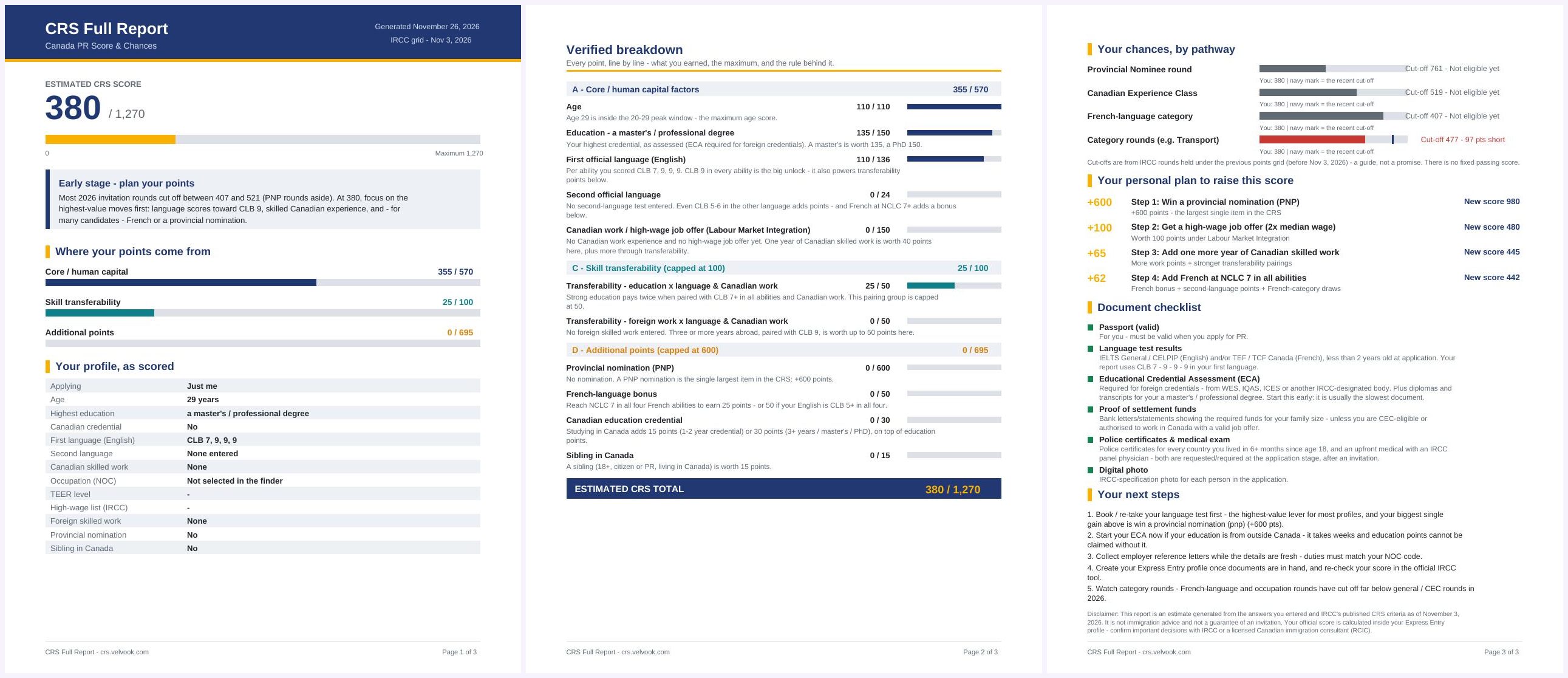
Sample of the 3-page CRS full report: score and category breakdown, chances by pathway, personal points plan and document checklist
This is the real $1.99 report — all 3 pages, generated from a test profile (score 380). Yours is built from your own answers, on this page, the moment you unlock it. Nothing is emailed and nothing is made up: every number comes from the answers you enter above.

Not sure how to use the calculator? We’ll do it with you.

Message us on WhatsApp and we’ll go through the questions together, calculate your personal CRS score on the new Nov 2026 rules, and send you your full report — your chances in every pathway, your personal plan to gain points, and the 3-page PDF.

A score-calculation and report service using IRCC’s published grid — an estimate only, not immigration advice. One-time payment, no subscription.

$9.99 one-time

+1 226 577 4101

Questions people ask

What CRS score do I actually need for PR?

There is no fixed pass mark. IRCC invites the highest-ranked profiles in each round, so the cut-off moves: recent Canadian Experience Class rounds closed at 518–521, French-language rounds at 407–435, and the last Transport occupations round at 477. A provincial nomination adds 600 points and effectively guarantees an invitation in a PNP round.

What changed on November 3, 2026?

IRCC added a Labour Market Integration factor worth up to 150 points. Canadian work in a high-wage occupation now earns a bonus of 20, 40 or 70 points on top of the usual work-experience points, and a job offer in a high-wage occupation earns 50, 70 or 100 points again — with no LMIA required. You get points for Canadian work or a job offer, whichever is worth more, not both. The maximum CRS score rose from 1,200 to 1,270.

What is a NOC code, and how do I find mine?

A NOC code is the 5-digit number Canada’s National Occupational Classification gives your occupation. The first digit is the broad field of work; the second digit is the TEER level (0–5) — how much training, education, experience and responsibility the job usually requires. Only work in TEER 0, 1, 2 or 3 counts as skilled and earns CRS points, category-based draws target specific NOC codes, and your code is what links your job to its published median wage. To find yours, match your actual day-to-day duties — not your job title — against the lead statement and main duties on IRCC’s “Find your NOC” page or the official NOC website (NOC 2021). Picking a code your duties don’t support can get that work experience refused.

What is a median wage occupation — and is it my salary?

No — it is not your salary. Every occupation (by NOC code) has a published median wage in Canada: the middle hourly pay, where half the workers in that occupation earn more and half earn less. IRCC compares that occupation median to the national median wage across all occupations. If the occupation’s median is at least 1.3×, 1.5× or 2× the national median, it counts as a high-wage occupation for the new Labour Market Integration points (20/40/70 points for Canadian work, or 50/70/100 for a job offer). You can check your occupation’s Canada-wide median on the Government of Canada Job Bank wages page using your NOC code.

Why is language worth so much?

Your first language alone is worth up to 136 core points, and it also unlocks skill-transferability points: reaching CLB 9 in all four abilities can add up to 50 transferability points with a strong degree and 50 more with foreign work experience. For many candidates, one IELTS re-take is worth more than a year of waiting.

Is this the official IRCC calculator?

No. This is an independent tool that applies IRCC’s published CRS criteria so you can understand every point. Your official score is the one calculated inside your Express Entry profile, and only IRCC can issue an invitation. Always confirm important decisions with IRCC or a licensed Canadian immigration consultant (RCIC).

Do job offers still need an LMIA?

For CRS points, no — since November 3, 2026, only offers in high-wage occupations earn points (50–100), and no LMIA is required. Between March 25, 2025 and November 2, 2026, job offers earned no CRS points at all.